
Forkhead Box Protein M1 (FOXM1) is a transcription factor that plays a critical role in cell cycle regulation, proliferation, and differentiation. It is a member of the Forkhead box family of transcription factors and is involved in various biological processes, particularly in the regulation of genes required for mitotic progression. Overexpression of FOXM1 has been linked to several cancers, including breast, lung, liver, and prostate cancers, making it a valuable biomarker in cancer research. The Human FOXM1 ELISA (enzyme-linked immunosorbent assay) is a sensitive and specific tool for detecting and quantifying FOXM1 protein levels in biological samples, facilitating research into cancer progression and potential therapeutic interventions.

Principle of the Human FOXM1 ELISA
The Human FOXM1 ELISA is designed to detect FOXM1 protein in various sample types, such as serum, plasma, and cell culture supernatants. The assay operates on the antigen-antibody interaction principle:
- Capture Antibody: A specific antibody targeting FOXM1 is immobilized onto the wells of the ELISA plate.
- Sample Binding: Samples containing FOXM1 are added, allowing the protein to bind to the immobilized antibodies.
- Detection Antibody: A secondary antibody conjugated with an enzyme binds to the captured FOXM1.
- Enzymatic Reaction: A substrate is added, which the enzyme converts into a detectable signal, usually a color change, proportional to the amount of FOXM1 in the sample. This quantitative analysis provides valuable insights into the protein’s concentration.
This method allows for the precise measurement of FOXM1 levels, which is crucial in understanding its role in both normal and cancerous cells, as supported by research from National Cancer Institute (NCI).
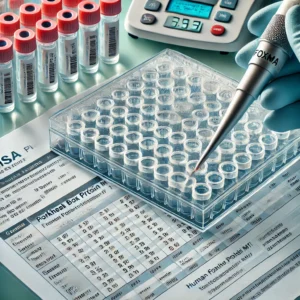
Applications of Human FOXM1 ELISA in Research
- Cancer Research: FOXM1 is overexpressed in many types of cancers, where it promotes tumor growth, invasion, and metastasis. The Human FOXM1 ELISA is widely used to study the correlation between FOXM1 levels and cancer progression. Studies from National Institutes of Health (NIH) have shown that FOXM1 overexpression is associated with poor prognosis in cancers such as breast, prostate, and lung cancer. By quantifying FOXM1, researchers can evaluate its potential as a prognostic marker or therapeutic target.
- Cell Cycle Regulation: FOXM1 is essential for the progression of the G2/M phase of the cell cycle. The detection of FOXM1 through ELISA enables scientists to study its involvement in cell cycle regulation and its impact on cellular proliferation. According to research by Johns Hopkins Medicine, FOXM1’s role in regulating mitotic genes makes it a key focus in studies related to cell cycle dysregulation, a hallmark of cancer.
- Drug Development: Given FOXM1’s role in tumor progression, it is considered a target for cancer therapeutics. Using FOXM1 ELISA, researchers can screen for compounds that inhibit FOXM1 expression or activity. By measuring changes in FOXM1 levels in treated samples, potential therapeutic agents can be evaluated for their effectiveness in suppressing FOXM1-mediated tumorigenesis, as noted in studies published by Harvard Medical School.
- Regenerative Medicine: FOXM1 is also involved in tissue regeneration and repair, particularly in liver and lung tissues. Quantifying FOXM1 levels in regenerative studies helps in understanding its role in tissue repair mechanisms and exploring its potential in regenerative therapies, as highlighted by research from Stanford University.
Advantages of Human FOXM1 ELISA
- High Sensitivity and Specificity: The FOXM1 ELISA is highly sensitive, allowing for the detection of low levels of FOXM1 protein in various sample types. Its specificity ensures that it measures FOXM1 without cross-reactivity with other proteins.
- Quantitative Measurement: The assay provides precise quantification of FOXM1 levels, which is essential for understanding its role in cancer progression and cellular processes.
- Versatility: The ELISA can be used with a wide range of sample types, including serum, plasma, and cell culture media, making it suitable for both basic research and clinical studies.

Challenges and Considerations
While the Human FOXM1 ELISA is a powerful tool, there are several considerations for achieving optimal results:
- Sample Handling: Proper handling of samples is critical to prevent degradation of FOXM1 protein, which could lead to inaccurate results. Researchers must ensure that samples are collected and stored under appropriate conditions, as recommended by the U.S. Food and Drug Administration (FDA).
- Interference: In some cases, certain biological components in the sample, such as lipids or hemoglobin, may interfere with the assay’s performance. Careful sample preparation and dilution may be required to minimize interference.
Conclusion
The Human FOXM1 ELISA is a vital tool in cancer research, cell cycle studies, and drug development. By providing a reliable method to quantify FOXM1 protein levels, this assay allows researchers to explore the protein’s role in tumor progression, cellular proliferation, and tissue regeneration. As research into FOXM1 continues, the ELISA will remain a crucial technique for advancing our understanding of this important transcription factor and its potential as a target for cancer therapies.